





An upward trend
Currently, the forest area (referred to as polish "Ls"), as recorded in the public register (equivalent to the real estate cadastre) known as the Land and Building Register, maintained for Poland by the National Geodetic Institute, amounts to:
9,283,800 hectares (excluding land related to forest management, such as buildings, roads, and squares), which corresponds to a forest cover of 29.6%. There has been a steady increase in the share of forest in the total area of the country. In 1946, it was 20.8%, meaning it has increased by nearly one-third over the last 80 years.
These are officially accepted data, provided by the Central Statistical Office (Statistics Poland) as of January 1, 2023. The information collected covers all forms of ownership: those managed by the State Forests National Forest Holding (State Forests), national parks, the State Treasury's Agricultural Property Resource (National Support Center for Agriculture), other State Treasury properties, and other public (reported collectively), municipal, and private properties.
Forests in Poland are protected in a variety of ways. Primarily, the 1991 Forest Act, as amended, defines the following in Article 6.1, point 1a:
"Sustainable forest management" means activities aimed at shaping the structure of forests and their use in a manner and at a rate that ensures the permanent preservation of their biological richness, high productivity and regenerative potential, vitality, and ability to fulfill, now and in the future, all important protective, economic, and social functions at the local, national, and global levels, without harming other ecosystems.
Article 6.1, however, provides: 7. 1. Clarifies that sustainable forest management is carried out in accordance with a forest management plan or a simplified forest management plan, taking into account, in particular, the following objectives:
1) the preservation of forests and their beneficial impact on the climate, air, water, soil, human living conditions and health, and the natural balance;
2) the protection of forests, especially forests and forest ecosystems that constitute natural fragments of native nature or forests particularly valuable due to:
a) the preservation of natural diversity, b) the preservation of forest genetic resources, c) landscape values, d) scientific needs;
3) the protection of soils and areas particularly vulnerable to pollution or damage and of special social importance;
4) the protection of surface and deep waters, the retention of catchments, particularly in watershed areas and in areas feeding groundwater reservoirs;
5) the production, based on the principle of rational management, of timber, raw materials, and by-products of forest use.
In point Section 2 of this article states that:
"Forest management in forests constituting nature reserves and those included in national parks shall take into account the principles specified in the regulations on nature conservation."
And Section 2 states that:
"The provisions of this Act shall apply to forests, regardless of their form of ownership." Chapter 3 of this Act is devoted to protective forests. It explains which forests are considered protective and the procedure for adopting this status.
Many other legal acts also address the protection of forest areas.
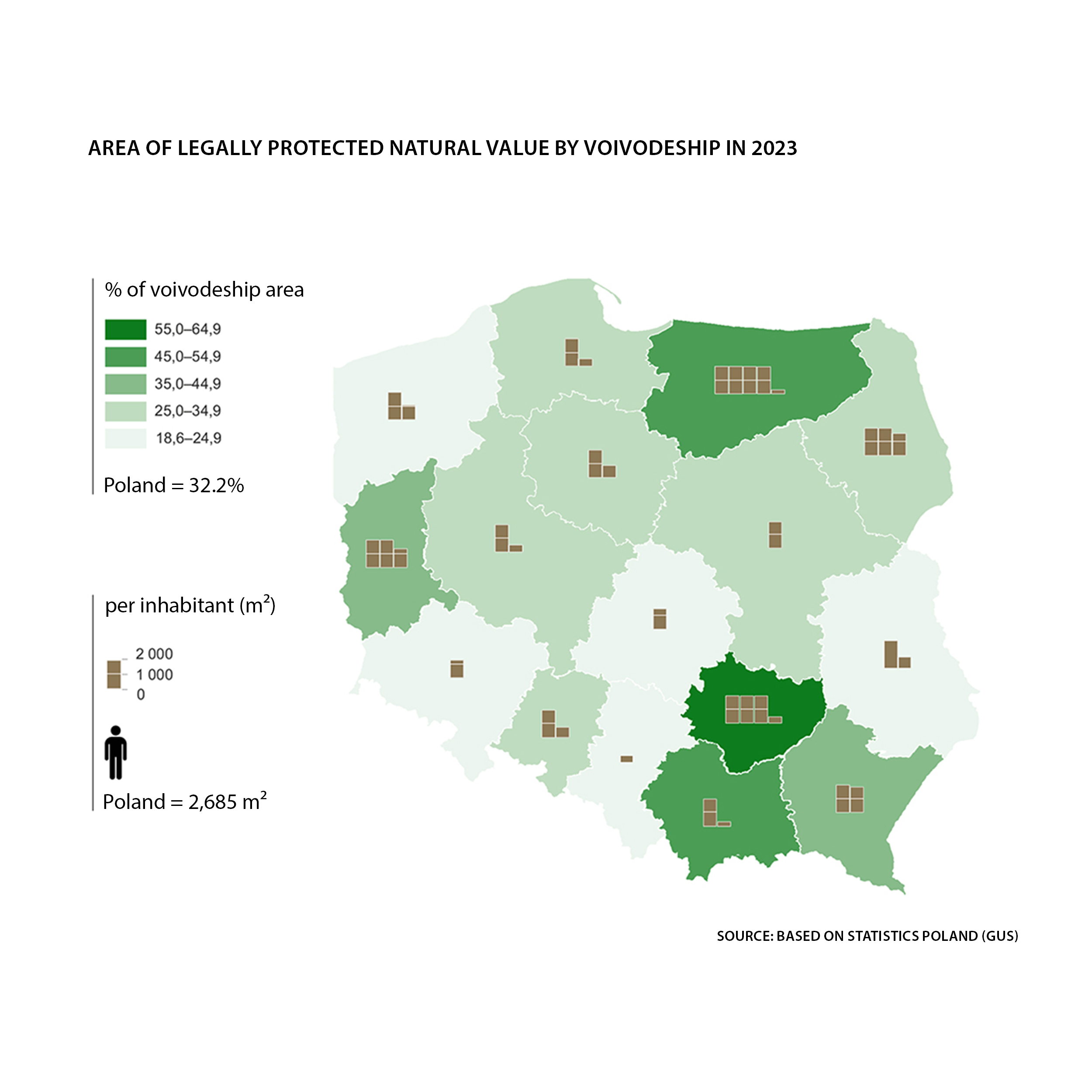
The BDL database contains information on forest area, growth, stand density, volume of living and dead trees, and standing stock. Data is presented in tabular summaries, which can be generated independently (tab in the Navigator>Summaries). These are summary summaries compiled according to specific thematic categories, ownership forms, and are broken down by voivodeship, natural forest region, and regional State Forests directorate. Forest area can be examined by ownership type, age classes and subclasses, dominant species, forest habitat types, and management methods for a selected area of the country. This data is aggregated and presented collectively, in quantitative and percentage formats.
From a variety of summary options, you can select data on, among other things, the share of individual tree species in the total forest area.
For the country, these values currently stand at 68.8% for conifers, 59.1% for pine, and 8% for oak (NFI, 2024).
The volume per hectare is currently 293 m3, which is higher than the previous measurement (NFI, 2024). Damage to stands is classified according to various criteria. Dead trees, standing trees, and fallen trees are measured.
Currently, forests across the country contain an average of approximately 11.8 m3/ha of gross deadwood.
The average volume of standing dead trees in forests of all ownership types totals 5.4 m3/ha.
The highest volume of standing dead trees per hectare is found in national parks (20.0 m3/ha). The corresponding volume in State Forests was 4.9 m3/ha, and in private forests 5.4 m3/ha.
Sources: Statistics Poland, NFI, sejm.gov.pl.